Why Metal Roofing Is Ideal for Hawaii Homes
Metal roofing offers exceptional performance in Hawaii's demanding climate. From coastal properties facing constant salt exposure to mountain homes enduring heavy rainfall, metal roofs provide durability that other materials simply can't match.
When you're searching for a roofer near me for metal roof installation, you need contractors who understand the specific requirements of metal roofing in Hawaii. Proper material selection, correct fastening methods, and appropriate coatings make the difference between a roof that lasts 50+ years and one that corrodes prematurely.
Unmatched Longevity: While asphalt shingles typically last 20-30 years in Hawaii, quality metal roofs routinely last 40-70 years. Many metal roofs installed decades ago are still performing today. For homeowners who want to install one roof and never think about it again, metal delivers.
Salt Air Resistance: Hawaii's coastal environments are brutal on roofing materials. Salt air corrodes fasteners, degrades coatings, and accelerates wear on conventional roofing. Properly specified metal roofing with appropriate coatings and stainless steel fasteners withstands salt exposure that would destroy other materials.
Wind Resistance: Metal roofs can withstand winds of 140 mph or higher when properly installed. Hawaii's trade winds, Kona winds, and tropical storms are no match for a correctly installed metal roof. The interlocking panels of standing seam systems are particularly wind-resistant.
Energy Efficiency: Reflective metal roofing dramatically reduces cooling costs. Metal roofs can be 50-60 degrees cooler than dark asphalt shingles on sunny days. In Hawaii where air conditioning is a major expense, this translates to real savings on your HECO bill.
Low Maintenance: Unlike shingle roofs that need periodic replacement or tile roofs that require ongoing repairs, metal roofs need minimal maintenance. Occasional inspection and cleaning is typically all that's required to keep a metal roof performing for decades.
Fire Resistance: Metal roofing is non-combustible, providing excellent fire protection for your home. This can be particularly valuable in drier areas of Oahu or for homes near brush.
Types of Metal Roofing We Install
Different metal roofing profiles suit different applications and aesthetics. We work with contractors experienced in all major metal roofing systems:
Standing Seam Metal Roofing
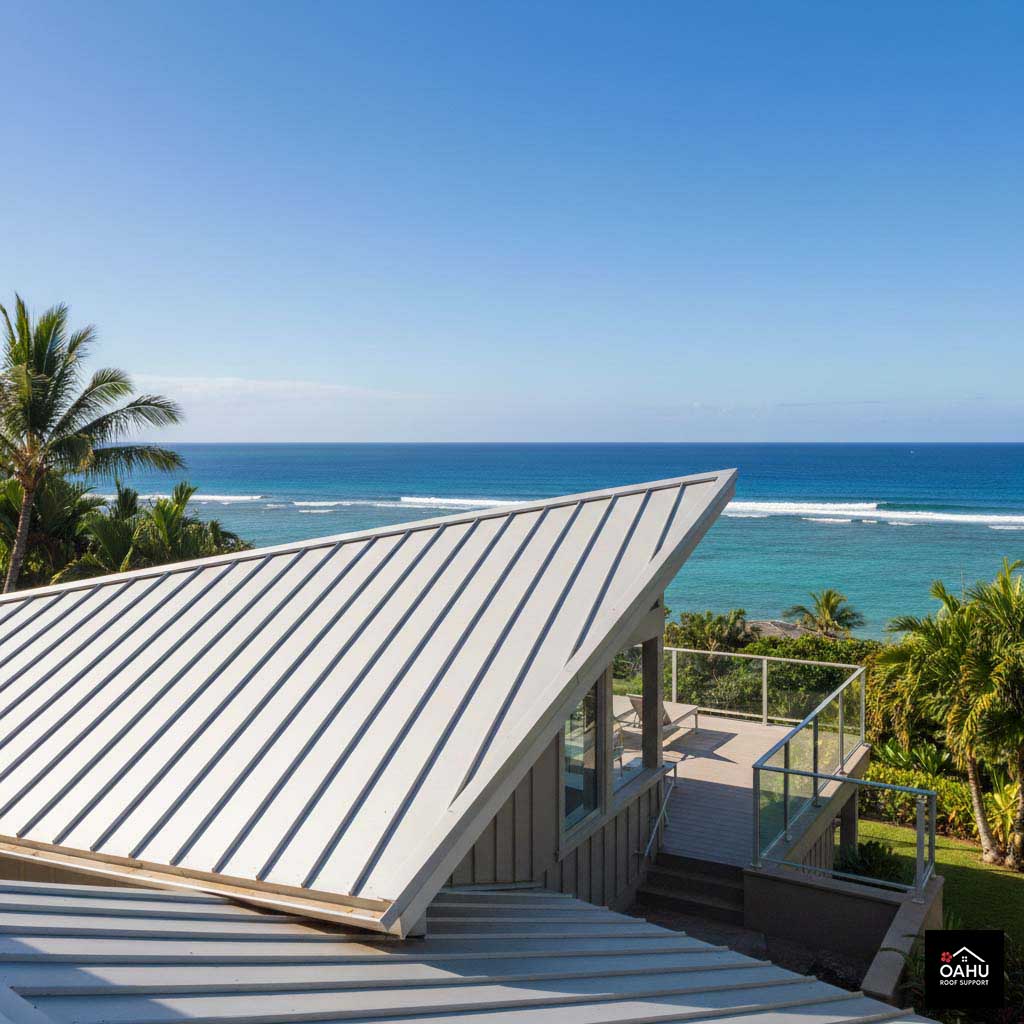
Standing seam is the premium choice for residential metal roofing. The raised seams and concealed fasteners create a clean, modern appearance while providing superior weather resistance.
How It Works: Standing seam panels interlock at raised seams that stand 1-3/4 inches above the roof surface. Fasteners are hidden within the seams, protecting them from weather and eliminating potential leak points at fastener penetrations. Panel clips allow the metal to expand and contract with temperature changes without stress.
Panel Options: We install standing seam systems in various configurations to match your home's architecture and performance requirements. Common panel widths include 14 and 18 inches, with seam heights typically ranging from 1 to 2 inches. Snap-lock systems offer efficient installation, while mechanical seam systems provide maximum wind resistance for coastal and high-wind applications.
Premium Systems We Install: We work with top-tier standing seam products including the Custom-Bilt Metals TITAN SL-1750, a snap-lock panel available in 24-gauge Galvalume steel with Kynar 500 finish. This system features a 1-3/4 inch seam height with 14 or 18 inch panel widths, and carries an impressive 35-year no-fade finish warranty. The TITAN Cool Roof reflective paint system meets Energy Star requirements and can reduce cooling costs by up to 20%.
Advantages: Concealed fasteners mean no exposed screws to corrode or leak. The interlocking design provides exceptional wind resistance. Clean lines offer a contemporary aesthetic that complements modern architecture. Panel clips and concealed fasteners are heavy-duty galvanized or coated bi-metal to match roof color and resist corrosion.
Complete System Components: A quality standing seam installation includes more than just panels. Our installations include 3-inch drip edge, rake and rake support trim, ridge and hip caps, valley flashing, sidewall flashing, and EPDM pipe boots. All metal flashings are color-matched to your roof for a unified appearance.
Underlayment: Beneath the metal panels, we install premium self-adhering vapor barrier underlayment like Palisade SA-HT 40mil. This high-temperature underlayment is rated to 250°F and provides superior protection against moisture intrusion. The self-adhering design seals around fasteners and provides a secondary waterproofing layer.
Batten System: For optimal performance, we install standing seam over 1x3 pressure-treated wood battens spaced at 3 feet on center. This creates an air gap between the metal and roof deck that improves ventilation, reduces heat transfer, and allows for thermal expansion.
Best Applications: Standing seam is ideal for visible roof surfaces where appearance matters, coastal properties where fastener corrosion is a concern, and homeowners who want the longest-lasting roof possible. The system works on roof pitches as low as 1/2:12 with proper installation.
Corrugated Metal Roofing
Corrugated metal is a classic Hawaii roofing material with decades of proven performance. The wave-pattern panels are economical, durable, and well-suited to our climate.
How It Works: Corrugated panels feature a repeating wave pattern that adds strength and rigidity. Panels overlap at edges and are fastened through the raised portions of the waves.
Advantages: Cost-effective compared to standing seam. Proven performance in Hawaii conditions. Easy to repair if damaged. Familiar to most roofing contractors. Good for agricultural, utility, and residential applications.
Considerations: Exposed fasteners require appropriate materials (stainless steel in coastal areas) and periodic maintenance. Less refined appearance than standing seam. Proper installation technique is important to prevent leaks at fastener points.
Best Applications: Corrugated metal works well for carports, agricultural structures, utility buildings, and homes where budget is a priority. It's also appropriate for traditional plantation-style homes where the corrugated look is architecturally consistent.
Metal Shingle and Tile Profiles
Metal roofing that mimics the appearance of shingles, tiles, or shake provides the longevity of metal with a more traditional aesthetic.
How It Works: Stamped metal panels are formed to resemble wood shake, slate, tile, or traditional shingles. They install similarly to conventional roofing while providing metal's durability.
Advantages: Traditional appearance acceptable in neighborhoods where modern metal might not fit. Metal durability and longevity. Lightweight compared to actual tile. HOA-friendly in communities that don't allow standing seam.
Best Applications: Homes in traditional neighborhoods, properties with HOA restrictions on roofing appearance, and homeowners who want metal performance with a conventional look.
Ribbed and R-Panel Metal Roofing
Ribbed panels offer an economical metal roofing option with clean lines and good performance.
How It Works: R-panels and ribbed panels feature raised ribs for strength, with exposed fasteners. They're commonly used in commercial and agricultural applications but also work for residential.
Advantages: Economical installation. Good structural strength. Clean, industrial aesthetic. Readily available and easy to source.
Best Applications: Carports, workshops, agricultural buildings, and modern homes where an industrial aesthetic is desired.
Aluminum Interlock Roofing
Aluminum interlock roofing systems are extremely popular throughout Hawaii, and for good reason. These systems combine the corrosion resistance of aluminum with an interlocking design that provides exceptional wind and water protection.
How It Works: Aluminum interlock shingles or panels connect to each other through a mechanical interlocking system. Each piece locks into the one below and beside it, creating a unified roof surface that resists wind uplift and water penetration. The interlocking design means the roof acts as a single unit rather than individual pieces.
Why It's Popular in Hawaii: Aluminum interlock roofing was practically made for Hawaii conditions. The solid aluminum construction never rusts, even in direct oceanfront exposure. The interlocking system withstands hurricane-force winds. The lightweight material doesn't stress roof structures. Many Hawaii homes have had aluminum interlock roofs performing flawlessly for 30, 40, even 50+ years.
Advantages: Superior corrosion resistance from solid aluminum construction. Exceptional wind resistance from the interlocking design, often rated for 120+ mph winds. Lightweight, typically 50-70% lighter than asphalt shingles. Available in multiple profiles including shake, slate, shingle, and tile appearances. Proven decades-long performance record in Hawaii. Low maintenance with no exposed fasteners to corrode.
Available Styles: Aluminum interlock systems come in various profiles to match different architectural styles. Shake profiles mimic wood shake appearance. Slate profiles provide an elegant traditional look. Shingle profiles offer a familiar appearance with metal durability. Tile profiles replicate the look of barrel or flat tile. All styles provide the same interlocking performance regardless of appearance.
Brands and Systems: Several manufacturers produce aluminum interlock roofing systems popular in Hawaii, including Classic Metal Roofing Systems, Interlock Roofing, and Kassel & Irons. Each system has slightly different profiles and installation methods, but all share the interlocking aluminum concept. We work with contractors certified in these specific systems.
Best Applications: Aluminum interlock is ideal for any Hawaii home, but particularly valuable for coastal properties, homes in high-wind areas, and homeowners who want maximum longevity with traditional aesthetics. It's an excellent choice when you want the durability of metal without the modern standing seam appearance.
Investment Value: Aluminum interlock systems typically cost more than corrugated or basic standing seam, but the combination of aesthetics, durability, and corrosion resistance makes them a strong value proposition for Hawaii homeowners planning to stay in their homes long-term.
Metal Roofing Materials for Hawaii Conditions
The metal substrate and coating system are critical for long-term performance in Hawaii. Not all metal roofing is created equal:
Aluminum
Aluminum offers the best corrosion resistance of any metal roofing material, making it ideal for coastal Hawaii properties.
Advantages: Naturally corrosion-resistant without coatings. Lightweight, reducing structural requirements. Doesn't rust even in constant salt exposure. Excellent longevity in marine environments.
Considerations: Higher cost than steel. Softer material that can dent more easily. Expansion and contraction require proper installation technique.
Best For: Oceanfront and coastal properties, areas with heavy salt exposure, and homeowners prioritizing maximum corrosion resistance.
Galvanized Steel
Steel coated with zinc (galvanized) offers good durability at a more accessible price point than aluminum.
Advantages: Strong and durable. Cost-effective. The zinc coating protects against corrosion. Widely available in various profiles.
Considerations: Zinc coating will eventually wear, particularly in salt air environments. Not recommended for direct oceanfront exposure. Quality of galvanization matters significantly.
Best For: Inland properties, areas with limited salt exposure, and budget-conscious projects where conditions aren't extreme.
Galvalume Steel
Galvalume combines zinc and aluminum coating on steel for improved corrosion resistance over standard galvanized, making it the most popular choice for standing seam installations.
What Is Galvalume: Galvalume is steel coated with an alloy of approximately 55% aluminum, 43.5% zinc, and 1.5% silicon. This combination provides better corrosion resistance than pure zinc galvanizing while being more economical than solid aluminum.
Gauge Options: Standing seam panels are typically available in 24 and 26 gauge Galvalume. 24-gauge is the standard for quality residential installations, offering the right balance of durability, rigidity, and weight. The heavier gauge resists denting and handles foot traffic better during installation and maintenance.
Advantages: Better corrosion resistance than galvanized steel. More economical than solid aluminum. Good balance of performance and value. The aluminum content provides salt resistance suitable for most Hawaii locations. When combined with premium Kynar coatings, Galvalume standing seam systems can last 40-50+ years.
Considerations: Still not as corrosion-resistant as solid aluminum in severe oceanfront exposure. Coating can be damaged during installation if not handled properly. For direct oceanfront properties within the salt spray zone, aluminum may be the better choice.
Best For: Most Hawaii residential applications. Excellent choice for properties with moderate salt exposure where aluminum's higher cost is a concern. The standard material for quality standing seam installations across Oahu.
Coating Systems
The paint or coating system on metal roofing is critical for longevity and appearance. In Hawaii's intense UV environment, coating quality makes a dramatic difference in long-term performance.
PVDF/Kynar 500 Coatings: Premium fluoropolymer coatings like Kynar 500 (also known as Hylar 5000 or Fluropon) contain a full 70% PVDF (Polyvinylidene fluoride) resin. These coatings offer exceptional UV resistance, color stability, chalk resistance, and durability. The best systems carry 35-year no-fade warranties, meaning less than 5 units of color change over decades of exposure. This is the coating standard we recommend for all visible roof surfaces in Hawaii.
Cool Roof Technology: Modern metal roof coatings incorporate reflective pigmentation that meets Energy Star requirements even in darker colors. The TITAN Cool Roof system, for example, achieves up to 60% reflectivity of the sun's heat, translating to energy savings of up to 20% on cooling costs. In Hawaii where air conditioning is a major expense, this technology pays dividends year after year.
Color Options: Premium coating systems are available in 25+ colors ranging from Regal White (SRI-87) to darker options like Midnight Bronze and Black. Each color is tested and rated for Solar Reflectance (SR), Thermal Emittance (TE), and Solar Reflectance Index (SRI). Even darker colors in quality systems maintain good performance characteristics.
SMP Coatings: Silicone-modified polyester coatings offer good performance at lower cost than PVDF. Suitable for less visible applications or budget-conscious projects where a 35-year fade warranty isn't necessary.
Coating Durability: Quality PVDF coatings pass rigorous testing including 3,000+ hours of salt spray resistance, 3,000+ hours of humidity resistance, and 3,000+ hours of UV exposure testing. They resist acid rain, detergents, and pollutants. This durability is why premium-coated metal roofs can look good for 40+ years in Hawaii's demanding environment.
Fasteners and Hardware for Hawaii Installations
Fasteners are often the weak point in metal roof installations. In Hawaii's corrosive environment, proper fastener selection is critical:
Stainless Steel Fasteners: For coastal properties and exposed fastener systems, stainless steel is essential. Standard galvanized fasteners will corrode and fail prematurely in salt air. We specify 304 or 316 stainless steel for maximum corrosion resistance.
Coated Fasteners: For inland applications, properly coated fasteners may be adequate. The coating should match or exceed the durability of the roof panels themselves.
Proper Washers: EPDM or neoprene washers seal fastener penetrations. Quality washers maintain seal for decades; cheap washers deteriorate and allow leaks. We specify appropriate washer materials for each application.
Clip Systems: Standing seam roofs use clip systems that allow panels to float and accommodate thermal movement. Proper clip selection and installation ensures long-term performance without stress on panels or fasteners.
Combining Metal Roofing with Flat Roof Sections
Many Hawaii homes have a combination of pitched roof areas and flat or low-slope sections. When installing a new metal roof on the main structure, we can also address these secondary roof areas:
Existing Modified Bitumen Sections: If your home has a flat carport, lanai, or addition with modified bitumen roofing, we can extend its life with a fluid-applied roof coating system. This involves pressure washing the existing surface, applying seam sealant to flashings and penetrations, and coating with premium silicone like GACO S20. This approach can add 10+ years of life to an aging mod bit roof at a fraction of replacement cost.
Skylight Replacement: While the roof is being worked on, it's an ideal time to replace aging skylights. We can install new fixed curb-mounted skylights in common sizes like 24" x 48" as part of the roofing project, ensuring proper flashing integration with both metal and flat roof sections.
Coordinated Warranties: When we handle both the metal roof and flat roof coating in one project, you get coordinated warranties and a single point of accountability. The metal sections carry 7-year workmanship and 30-year material warranties, while coating systems typically carry 7-year workmanship and 10-year material warranties.
Metal Roof Warranties
Quality metal roofing comes with robust warranty coverage that reflects the material's exceptional longevity:
Material Finish Warranty: Premium standing seam systems with Kynar 500 coatings typically carry 30 to 35-year material finish warranties. This covers fading, chalking, and coating integrity. The 35-year no-fade warranty on systems like the Custom-Bilt Metals TITAN means your roof will look good for decades, not just perform well.
Workmanship Warranty: Our certified installers provide 7-year workmanship warranties covering installation defects. This warranty protects you if any issues arise from the installation process rather than material defects.
Substrate Warranty: The underlying metal carries its own warranty against perforation and structural failure. Quality Galvalume panels are warranted against rust-through for 20-25 years or more.
Why Warranties Matter: Unlike shingle warranties that prorate after a few years, quality metal roof warranties maintain full coverage for extended periods. A 30-year material warranty on metal roofing provides real protection because the roof will actually last that long. With shingles, the roof often fails before the warranty period ends.
Warranty Requirements: To maintain warranty coverage, metal roofs must be installed according to manufacturer specifications by qualified contractors. Our installer network meets these requirements, ensuring your warranty is valid from day one.
Metal Roof Installation Across All of Oahu
We serve homeowners across the entire island, with special expertise in coastal and salt-exposed properties:
North Shore (Haleiwa, Kahuku, Laie): Direct ocean exposure makes the North Shore one of the most demanding environments for roofing materials. We specify aluminum or premium Galvalume with Kynar coatings and stainless steel fasteners for North Shore installations. Metal roofing's salt resistance makes it an excellent choice for this area.
Windward Coast (Kaneohe, Kailua): Heavy rainfall and salt-laden trade winds require roofing that handles both moisture and corrosion. Metal roofing's water-shedding capabilities and corrosion resistance make it ideal for windward properties. We ensure proper pitch and drainage for the area's high rainfall.
Ewa Beach and Kapolei: West Oahu's intense sun means reflective metal roofing provides significant energy savings. Cool roof coatings and light colors keep homes cooler and reduce HECO bills. We recommend high-performance coatings for west side installations.
Hawaii Kai and East Honolulu: Coastal exposure along the east side requires salt-resistant materials. Many Hawaii Kai homes are ideal candidates for standing seam metal roofing that combines durability with aesthetic appeal.
Waianae Coast: Salt air and intense sun create demanding conditions. We specify materials and coatings appropriate for Waianae's environment, ensuring long-term performance.
Mililani and Central Oahu: While further from the coast, Central Oahu still experiences salt-laden trade winds. Metal roofing's durability and energy efficiency make it an excellent choice for Mililani homes, with material selection adjusted for the reduced (but still present) salt exposure.
Pearl City and Aiea: Established neighborhoods in Pearl City and Aiea include many homes that would benefit from metal roof upgrades. The investment in metal pays dividends through decades of maintenance-free performance.
Insurance Coverage for Metal Roof Installation
Storm damage to existing roofs may qualify for insurance coverage that can fund your metal roof upgrade:
Storm Damage Claims: If your current roof has damage from wind, storms, or other covered events, your insurance may pay for replacement. While insurance typically pays for like-kind replacement, you can often upgrade to metal roofing by paying the difference between what insurance covers and metal roofing cost.
Insurance Discounts: Some insurance carriers offer premium discounts for metal roofing due to its wind and fire resistance. The discount may not be dramatic, but it adds to the financial case for metal roofing over time.
Our Documentation Process: We document existing roof damage thoroughly to support insurance claims. If your current roof has claimable damage, we help you navigate the process and understand your options for upgrading to metal.
Long-Term Value: While metal roofing has higher upfront cost than shingles, you'll likely never file another roof-related insurance claim. The roof you install may outlast your ownership of the home.
Working With Your Insurance Company
We work with all major insurance carriers serving Oahu homeowners:
State Farm. Allstate. FICOH (First Insurance Company of Hawaii). Island Insurance. DTRIC. And all other Hawaii homeowners insurance providers.
Each insurance company has different claim processes and upgrade policies. Our experience working with these carriers helps ensure your claim is handled properly and you understand your options for using insurance proceeds toward a metal roof upgrade.
The Metal Roof Installation Process
Proper installation is critical for metal roof performance. Here's what a quality standing seam installation involves:
Initial Consultation: We discuss your goals, assess your property, and recommend appropriate metal roofing options. We consider your home's architecture, coastal exposure, budget, and aesthetic preferences.
Detailed Assessment: We evaluate your existing roof structure to ensure it can support metal roofing. While metal is lighter than tile, we check for any issues that should be addressed before new roofing goes on. We measure the roof area precisely for accurate material ordering.
Material Specification: Based on your location and requirements, we specify the appropriate metal substrate, gauge, coating system, fasteners, and accessories. For most Hawaii installations, we recommend 24-gauge Galvalume with Kynar 500 coating and stainless steel or coated bi-metal fasteners.
Demo and Tear-Off: We remove existing roofing materials down to the deck. This includes disposing of old metal roofing, shingles, or other materials. For roofs with multiple layers, additional demo may be required to reach solid decking.
Deck Inspection and Repair: With the old roofing removed, we inspect the roof sheathing for damage, rot, or deterioration. Any damaged decking is repaired or replaced. For older homes with shiplap decking, we can repair sections as needed.
Underlayment Installation: We install premium self-adhering vapor barrier underlayment over the existing roof sheathing. Products like Palisade SA-HT 40mil provide high-temperature resistance (rated to 250°F), superior adhesion, and a secondary waterproofing layer. This underlayment carries a limited lifetime warranty.
Batten Installation: For standing seam systems, we install 1x3 pressure-treated wood battens spaced at 3 feet on center over the underlayment. This batten system creates an air gap for ventilation, reduces heat transfer to the attic, and provides a solid attachment point for panel clips.
Panel Installation: Standing seam panels are installed according to manufacturer specifications. Panel clips attach to the battens, and panels snap or mechanically lock into place. The concealed fastener system means no exposed screws penetrating the roof surface.
Flashing and Trim: All roof details are finished with color-matched metal trim and flashing. This includes 3-inch drip edge at eaves, rake trim with rake support, ridge and hip caps, valley flashing, sidewall flashing, and EPDM pipe boots around penetrations. Quality metalwork at these details is critical for long-term performance.
Final Inspection: We inspect the completed installation, verify all seams are properly locked, and ensure drainage is correct. You receive warranty documentation for both materials and workmanship, plus maintenance recommendations.
Metal Roof Maintenance
One of metal roofing's biggest advantages is minimal maintenance requirements:
Annual Inspection: Visual inspection once a year catches any issues early. Look for loose panels, damaged flashing, or debris accumulation in valleys.
Debris Removal: Clear leaves, branches, and debris from valleys and gutters. Accumulated debris holds moisture and can accelerate wear in those areas.
Fastener Check: For exposed fastener systems, periodically check that fasteners are tight and washers are intact. This is particularly important for corrugated roofing.
Coating Maintenance: Quality PVDF coatings last decades, but lower-quality coatings may need touch-up or recoating over time. We recommend premium coatings that minimize future maintenance.
Avoid Foot Traffic: While metal roofs can handle occasional foot traffic, unnecessary walking can dent panels and damage coatings. Use proper walking techniques when access is needed.
Why Choose Oahu Roof Support for Metal Roofing
We're not a roofing contractor. We're your local advocate who ensures you get the best outcome for your metal roof installation:
Free Assessments: No obligation assessments for homeowners considering metal roofing. We evaluate your property, discuss options, and provide honest recommendations.
Material Expertise: We understand the differences between metal substrates, coating systems, and profiles. We specify the right materials for your specific location and conditions, not a one-size-fits-all approach.
Coastal Specialization: We have particular expertise in metal roofing for coastal and salt-exposed properties. We know what materials and installation methods perform best in Hawaii's demanding coastal environments.
Insurance Navigation: If your current roof has storm damage, we help you navigate the claims process and understand your options for upgrading to metal roofing.
Independence: We're not tied to any single metal roofing manufacturer or contractor. We can objectively recommend the best product and installer for your specific situation.
Certified Installers: We work with contractors experienced in metal roof installation who follow manufacturer specifications and can offer strong warranties.
Frequently Asked Questions About Metal Roofing in Hawaii
Why should I use Oahu Roof Support instead of calling a metal roofer directly?
Metal roofing requires specific expertise, and not all contractors who claim to install metal do it correctly. I work with certified metal roofing specialists and can objectively recommend the right materials for your specific location. A contractor might push whatever product they stock; I recommend what's actually best for your coastal exposure, budget, and goals.
Do I pay more by going through Oahu Roof Support?
No. Roofing companies include their costs in pricing regardless of how you find them. The difference is that I connect you with metal roofing specialists and ensure proper material specification for your conditions. You're getting expertise that helps you avoid costly mistakes like using inadequate materials in coastal environments.
How much does metal roofing cost in Hawaii?
Metal roofing costs vary based on material and profile. Corrugated and ribbed panels typically run $8 to $14 per square foot installed. Standing seam ranges from $14 to $25 per square foot. Premium aluminum standing seam with Kynar coating can exceed $25 per square foot. These are rough ranges; actual costs depend on project specifics. While higher than shingles upfront, the 40-70 year lifespan often makes metal the most economical choice over time.
Is metal roofing worth the extra cost?
For most Hawaii homeowners, yes. When you calculate cost over the roof's lifetime, metal often costs less than replacing shingle roofs every 20-25 years. Add energy savings from reflective coatings and near-zero maintenance, and metal frequently provides the best long-term value. For coastal properties, metal's corrosion resistance makes it particularly compelling.
Will a metal roof make my house hotter?
No, the opposite. Reflective metal roofing with proper coatings is significantly cooler than dark shingles. The air gap between metal panels and roof deck provides additional insulation. Most homeowners see reduced cooling costs after switching to metal roofing.
Is metal roofing noisy in the rain?
Not with proper installation. Metal roofing installed over solid decking with appropriate underlayment is no louder than other roofing materials. The days of noisy metal roofs are based on agricultural buildings with no decking. Modern residential installations are quiet.
Can metal roofing withstand hurricanes?
Quality metal roofing installed correctly can withstand winds of 140 mph or higher. Standing seam systems with concealed fasteners are particularly wind-resistant. Hawaii's building codes require appropriate wind ratings, and metal roofing exceeds these requirements when properly installed.
Will my metal roof rust?
Not if properly specified for your location. Aluminum naturally resists corrosion without rusting. Galvalume and galvanized steel with appropriate coatings resist rust for decades. The key is matching material specification to your coastal exposure. We specify materials appropriate for your specific conditions.
How long does metal roofing last in Hawaii?
Quality metal roofing lasts 40-70 years in Hawaii with minimal maintenance. Aluminum and premium-coated Galvalume in coastal areas typically last 50+ years. Even in demanding salt air environments, properly specified metal dramatically outlasts other roofing materials.
Can I install solar panels on a metal roof?
Yes, and metal roofs are often ideal for solar. Standing seam systems allow rail-less solar mounting that doesn't penetrate the roof surface. Metal roofing's longevity means your roof will outlast your solar panels, avoiding the need to remove panels for re-roofing.
Does metal roofing attract lightning?
No more than any other material. Metal roofing doesn't attract lightning, and if lightning did strike, the metal would safely dissipate the charge across the roof surface. Metal is actually safer than some materials that could ignite from a strike.
Will my insurance cover metal roof installation?
Insurance covers damage from covered events, not upgrades. However, if your current roof has storm damage, you can use insurance proceeds toward a metal roof by paying the difference between what insurance covers and metal roofing cost. Some carriers also offer discounts for metal roofing's durability.
What is aluminum interlock roofing and why is it so popular in Hawaii?
Aluminum interlock roofing uses solid aluminum shingles or panels that mechanically lock together, creating a unified roof surface. It's extremely popular in Hawaii because the aluminum never rusts (even oceanfront), the interlocking design handles hurricane-force winds, and the systems have a proven track record of 40-50+ years in our climate. Many styles mimic shake, slate, or tile appearances while providing metal durability.
What if I'm not happy with the contractor's work?
Because I'm independent, I have real accountability. If a contractor in my network does poor work or uses incorrect materials, I address it. My reputation depends on connecting you with contractors who do quality metal roof installations.
Schedule Your Free Metal Roofing Consultation Today
Metal roofing offers unmatched durability for Hawaii homes, especially in coastal and salt-exposed environments. Whether you're planning a new installation, considering an upgrade from shingles, or dealing with storm damage to your current roof, we're here to help.
Whether you're on the North Shore, in Ewa Beach, Hawaii Kai, Mililani, or anywhere else on Oahu, we serve homeowners across the island with metal roofing expertise.
What happens when you reach out:
Fill out the form below or call us directly. We'll contact you within 24 hours to schedule. Your consultation is typically completed within 48 hours. You'll receive a detailed assessment, material recommendations matched to your location, and a clear path forward for your metal roof installation.
Prefer to call? Reach us directly at 808-766-8023