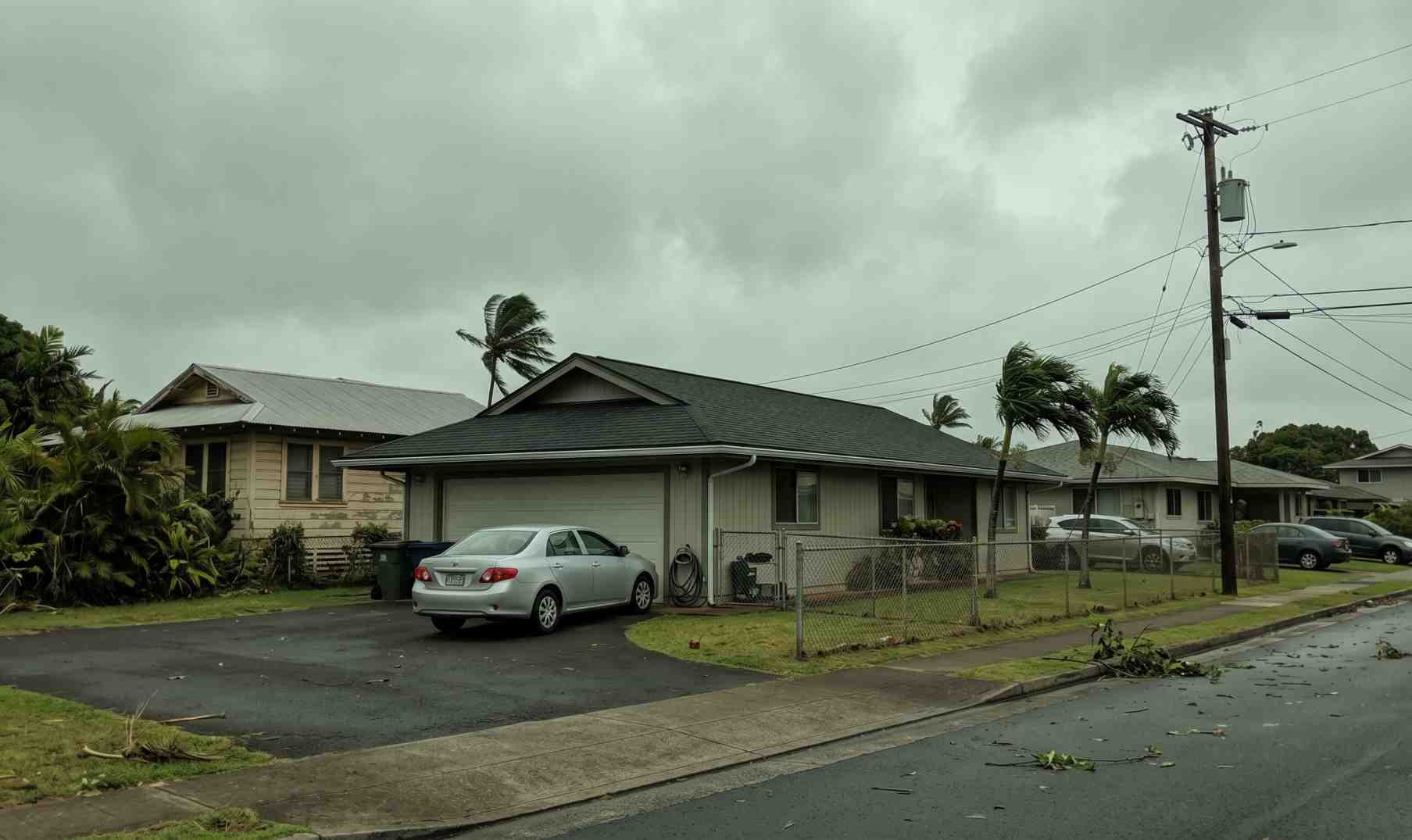
NOAA Just Forecast a Busy 2026 Hurricane Season for Hawaii
Aloha. If you have lived on Oahu for more than a season or two, you already know our weather can turn fast. On May 21, 2026, NOAA's Central Pacific Hurricane Center in Honolulu released its outlook for the 2026 hurricane season, and the short version is this: it is shaping up to be a busy one.
Here is what the forecast actually says, why El Niño puts Hawaii in a different position than the mainland, and the handful of things worth doing to your roof now, while the skies are still calm.
The 2026 Central Pacific Hurricane Forecast, in Plain Terms
NOAA's outlook for our basin (the central Pacific, which includes the Hawaiian Islands) calls for an above-normal season:
- A 70% chance of an above-normal season, with a 20% chance of near-normal and only a 10% chance of below-normal activity.
- 5 to 13 tropical cyclones expected across the central Pacific this year. A normal season sees about 4 or 5.
Hurricane season officially runs June 1 through November 30, so we are right at the front edge of it as you read this.
One thing I want to be straight with you about, because plenty of headlines are not: this is a forecast of how busy the ocean will be, not a prediction that a storm will hit Oahu. More activity in our waters raises the odds that something comes our way, but it is not a guarantee of a landfall. I would rather you be ready and have nothing happen than the other way around.
Why El Niño Puts Hawaii in a Different Position Than the Mainland
Here is the part most people get backwards. You may have heard that El Niño means a quiet hurricane season. That is true for Florida and the Gulf Coast. For Hawaii, it is the opposite.
Forecasters expect El Niño to develop and stay with us through the season. As of mid-May, NOAA still listed the Pacific as technically neutral but under an "El Niño Watch," which means El Niño is favored to form soon (about an 82% chance). How strong it gets is still an open question, and honestly nobody can tell you that part for certain yet.
So why does it matter for us? El Niño warms the ocean and calms the high-level winds (what meteorologists call wind shear) right in our stretch of the central Pacific. Warm water is the fuel storms feed on, and calmer winds let them hold together and grow. In NOAA's own words, strong El Niño conditions are "typically associated with dramatically elevated levels of activity in the central Pacific."
Over in the Atlantic, El Niño does the reverse. It cranks up the wind shear and tears storms apart before they can organize. Same climate pattern, opposite effect, and Hawaii sits on the rough side of it.
For a sense of scale: the strong El Niño back in 2015 produced 16 cyclones in the central Pacific, the busiest season on record here. That is not a prediction for 2026. It is a reminder that El Niño years in Hawaii deserve respect.
What a Busy Season Means for Your Roof
Your roof is the one part of your home that takes the full force of a Hawaii storm. Wind uplift, wind-driven rain, and flying debris all hit it first. The roofs that come through a storm are almost always the ones that were already in good shape going in. A loose ridge, a few lifted shingles, tired fasteners, or a small existing leak are exactly the weak points strong wind goes looking for.
The good news is that roof condition is one of the few storm variables you actually control. A little attention now is worth far more than a tarp in November. And if you just lived through the March 2026 Kona Low, keep in mind that storm may have already weakened your roof in ways you cannot see from the ground. We put together a full guide on what to do about Kona Low roof damage if you have not had yours checked yet.
Your Pre-Season Roof Checklist
You do not need to do everything at once, and you should not be climbing around up there yourself. If you only do a handful of things this month, make it these:
- Look up from the ground. Scan for lifted, cracked, or missing shingles, sagging spots, and anything loose along the ridges and edges.
- Clear your gutters and downspouts. Clogged gutters back water up under the roof edge during heavy rain, one of the most common ways storms cause interior damage.
- Trim back branches that overhang or touch the roof. In high wind those become both abrasion and flying debris.
- Photograph your roof now, before any storm. Clear, dated photos of your roof in good shape are one of the most valuable things you can have if you ever need to file a claim.
- Check your penetrations. Pipe boots, vents, and solar mounts are the first seals to fail under Hawaii's sun, and the first places wind-driven rain gets in.
- Know your hurricane deductible. Many Hawaii policies carry a separate hurricane deductible that works differently from your standard one. Know that number before you need it, not after.
If you would rather have a professional set of eyes on it, that is exactly what we do. A professional roof inspection catches the things a ground-level look cannot.
A Word on Insurance, Because It Matters More Than Ever
Hawaii is in the middle of a real property-insurance squeeze. Costs have climbed hard enough that the state stepped in. In July 2025, Governor Green signed a law to help stabilize the market and reactivate the Hawaii Hurricane Relief Fund. The Governor called rising insurance costs "yet another unbearable burden" for Hawaii families, and most homeowners I talk to feel that in their gut at every renewal.
What that means for you, practically: coverage is tighter and more expensive, deductibles are higher, and insurers are paying close attention to the condition of your home. A well-kept, documented roof is not just storm protection anymore. It is increasingly part of staying insurable at a fair price.
Here is a piece of Hawaii history worth knowing. Years ago, our state hurricane relief fund actually gave homeowners premium credits for hardening their roofs, including a discount for a new roof tied properly into the walls. That specific program is no longer running, but it points to something that has always been true here: a stronger, well-anchored roof has real value when the wind comes.
If a storm ever does damage your roof, document everything, do not throw anything away, and get your own set of eyes on it before you accept the first number. That is a longer conversation, and one we are glad to walk you through. We help homeowners across the island with insurance claim assistance so you are not facing the adjuster alone.
Frequently Asked Questions
Is the 2026 hurricane season going to be bad in Hawaii?
NOAA forecasts an above-normal season for the central Pacific, with a 70% chance of above-normal activity and 5 to 13 tropical cyclones expected, versus 4 or 5 in a normal year. Keep in mind an active season is about how busy the ocean gets, not a guarantee that a storm will hit Oahu. The smart move is to prepare either way.
Doesn't El Niño mean fewer hurricanes?
Not for Hawaii. El Niño suppresses hurricanes in the Atlantic by increasing wind shear, but it does the opposite in the central Pacific. It warms our waters and calms the shear, which tends to increase activity near the islands. The same pattern that quiets Florida tends to wake up our part of the ocean.
When is hurricane season in Hawaii?
The central Pacific hurricane season runs June 1 through November 30 each year, with activity usually peaking in late summer and early fall.
Has Hawaii ever been hit by a major hurricane?
Yes. Hurricane Iniki struck Kauai in September 1992 as the most destructive hurricane in modern Hawaii history. It is the reason our state hurricane relief fund was created in the first place, and a big part of why hurricane coverage works the way it does here today.
Does my homeowners insurance cover hurricane damage?
It depends on your specific policy. Standard homeowners policies generally cover wind and storm damage, but hurricane damage often falls under a separate hurricane deductible, which is commonly a percentage of your home's insured value rather than a flat dollar amount. Read your policy now, before the season ramps up, so there are no surprises. Not every storm is a declared hurricane either, which can change which deductible applies. Our guide to wind-damage claims in Hawaii breaks that down.
What should I do to my roof before hurricane season?
Clear your gutters, trim overhanging branches, look for lifted or damaged shingles, check the seals around pipes, vents, and solar mounts, and photograph your roof while it is in good shape. If your roof is older or you are unsure of its condition, get a professional inspection before the first big storm.
Get Storm-Ready Before the Season Peaks
I am Art, and I run Oahu Roof Support. We work roofs all across the island, from the North Shore to Mililani, Ewa, Kapolei, the Waianae Coast, Waipahu, and Kaneohe. Our job is to be in your corner. We inspect your roof, tell you straight what kind of shape it is in, help you document it properly for your insurance, and coordinate trusted, licensed crews to handle whatever work is actually needed. No pressure, no scare tactics, no mainland storm chasers. Just a clear picture and a plan from people who understand Hawaii roofs.
If you want peace of mind before this season gets going, the simplest next step is a roof check. Call or text us at (808) 517-5387, or fill out the form below, and we will set it up. A few minutes now can save you a very stressful November.
Stay safe out there, and mahalo for reading.
Last updated June 4, 2026. Forecast figures are from NOAA's Central Pacific Hurricane Center 2026 outlook (issued May 21, 2026) and NOAA Climate Prediction Center ENSO guidance (May 14, 2026). Seasonal outlooks change as the year develops, so we update this post as NOAA does.